
1. What is a Web Client?
2. What is a Web Server?
3. The Client-Server Request Loop
4. Testing Server Connectivity with ping
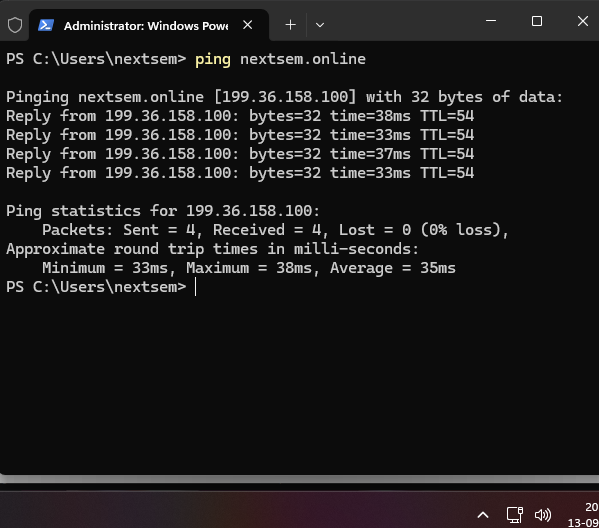
⊞Administrator: Windows 11 Command Prompt (cmd.exe)
>ping nextsem.online
⊞Windows 11 Execution OutputReal PC Match
Microsoft Windows [Version 10.0.22631.3007] (Windows 11 Pro x86_64)
(c) Microsoft Corporation. All rights reserved.
Pinging nextsem.online [199.36.158.100] with 32 bytes of data:
Reply from 199.36.158.100: bytes=32 time=18ms TTL=58
Reply from 199.36.158.100: bytes=32 time=16ms TTL=58
Reply from 199.36.158.100: bytes=32 time=17ms TTL=58
Reply from 199.36.158.100: bytes=32 time=19ms TTL=58
Ping statistics for nextsem.online:
Packets: Sent = 4, Received = 4, Lost = 0 (0% loss),
Approximate round trip times in milli-seconds:
Minimum = 16ms, Maximum = 19ms, Average = 17ms